Introduction
What if a single insult could galvanize 22 million people into a political movement? That’s exactly what happened in India when Supreme Court Chief Justice Surya Kant casually compared unemployed youth to cockroaches. Within weeks, a satirical joke had morphed into the Cockroach Janta Party (CJP)—a Gen Z-led digital uprising that now boasts more Instagram followers than Prime Minister Narendra Modi’s ruling Bharatiya Janata Party (BJP).
On June 6, 2026, the movement took its first real-world step, with hundreds of young Indians gathering at Delhi’s Jantar Mantar to demand the resignation of Education Minister Dharmendra Pradhan over exam paper leaks. The protest marked a pivotal moment: the internet joke had officially become a political force.
But is the Cockroach Janta Party a genuine threat to India’s political establishment, or just another fleeting internet trend? To understand its significance, we need to look beyond the memes and examine the deep-seated frustrations driving millions of young Indians to proudly declare, “I am a cockroach.”
The Birth of a Movement: From Insult to Emblem
Every great political movement needs a spark. For the CJP, that spark came on May 15, 2026, during a Supreme Court hearing. Chief Justice Surya Kant remarked: “There are youngsters like cockroaches, who don’t get any employment or have any place in the profession. Some of them become media, some of them become social media, RTI activists, and other activists, and they start attacking everyone.”
Kant later clarified that he was referring to individuals using fake degrees, not India’s youth broadly. But the damage was done. For millions of young Indians struggling with unemployment, rising costs, and a broken education system, the remark felt like a personal attack.
Enter Abhijeet Dipke, a 30-year-old political communications student at Boston University and former social media strategist for India’s Aam Aadmi Party (AAP).On May 16, Dipke posted a simple question on X: “What if all cockroaches came together?”
The response was overwhelming. Thousands of replies poured in, endorsing the idea.Dipke built a website and social media accounts for a parody political party in just two hours, with help from AI and friends. He called it the “Cockroach Janta Party”—a play on the ruling Bharatiya Janata Party (BJP).
Reclaiming the Insult
The genius of the CJP lies in its reclamation of the cockroach as a badge of honor. Cockroaches survive everything—poison, darkness, attempts to crush them.[reference:24] For Gen Z navigating grueling competition, hyperinflation, and shrinking opportunities, the metaphor resonated deeply.
“If they think we are cockroaches, then we will become cockroaches proudly,” became the movement’s unofficial mantra.
The Viral Explosion: 22 Million Followers in Weeks
The CJP’s growth was nothing short of meteoric. Within four days of launching its Instagram account, the party amassed more than 15 million followers—surpassing the BJP’s 8.8 million. Within a month, that number had ballooned to over 22 million. To put that in perspective: the only account to grow faster in Instagram history was K-pop star Kim Taehyung of BTS.
The Meme Machine
The movement’s success was fueled by a relentless stream of AI-generated memes, parody campaign slogans, and satirical commentary.Supporters created images of cockroaches delivering political speeches from the Red Fort or marching on Parliament. Hashtags like #CertifiedCockroach and #MainBhiCockroach (“I too am a cockroach”) trended nationwide.
A Self-Aware Satire
The CJP’s tongue-in-cheek manifesto explicitly embraced its absurdist roots. Membership required being “unemployed, lazy, chronically online, and able to rant professionally. “The party described itself as the “Voice of the Lazy and Unemployed.”Mock campaign promises included nap breaks and other playful demands.
But beneath the humor lay a serious political critique. The CJP’s website declared: “We are here to ask—loudly, repeatedly, in writing—where the money went.”
From Screens to Streets: The Jantar Mantar Protest
On June 6, 2026, the CJP faced its biggest test: could it translate digital outrage into real-world mobilization?
Dipke flew in from Boston that morning to lead the protest.[reference:45][reference:46] Despite police barricades at the airport and heavy security presence, he secured permission to hold the demonstration, posting: “Cockroaches gather at Jantar Mantar.”
A Colorful, Peaceful Demonstration
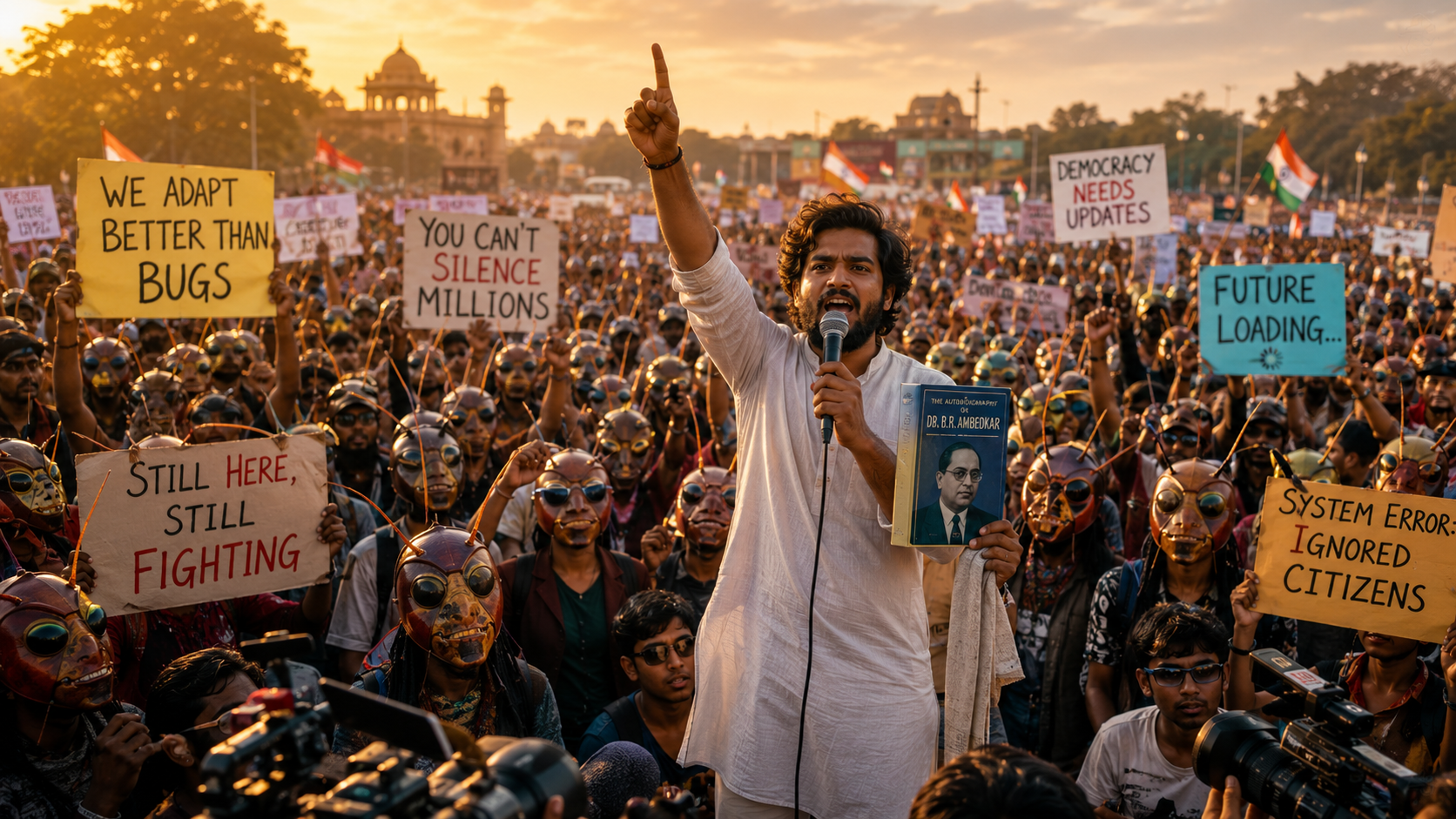
Hundreds—and by some estimates over 1,200[reference:51]—young Indians gathered at Jantar Mantar, many wearing cockroach masks and carrying flowers. School students attended alongside their parents. The atmosphere was festive yet purposeful. Placards read: “Waiting for exams that don’t leak” and “Cockroaches are coming, Dharmendra Pradhan is going!”
Supporters brought India’s national flag and books, symbolizing the right to education and equal opportunity. Organizers urged participants to remain peaceful and even offer flowers to police as a “gesture of compassion.”
The Demands
The immediate trigger was the NEET medical entrance exam scandal, where millions of students had their test canceled after question paper leaks were discovered. But the grievances ran deeper: a crumbling education system, scarce job opportunities, and a government perceived as indifferent to youth concerns.
Protesters demanded the resignation of Education Minister Dharmendra Pradhan.
An Unlikely Coalition
The protest drew support from an eclectic mix of figures. Climate activist Sonam Wangchuk addressed the crowd and promised a six-week fast if Dipke was arrested. Opposition leaders including Arvind Kejriwal, Manish Sisodia, and Mahua Moitra extended their backing.
The Political Establishment Strikes Back
Not everyone was amused. As the CJP’s influence grew, the Modi government responded with increasing alarm.
The X (Twitter) Block
In a move that sparked a constitutional debate, the CJP’s X account was withheld in India under national security provisions of the Information Technology Act. Dipke filed a petition in the Delhi High Court challenging the block as a violation of free speech. While the court declined to immediately restore the account, it formally sought responses from the government and X.
Accusations of Foreign Influence
Government officials, including Union Ministers Sukanta Majumdar and Kiren Rijiju, questioned the movement’s authenticity, suggesting it might be part of a coordinated cross-border influence operation. Independent researchers found little evidence to support these claims beyond standard internet virality.
The Opposition’s Defense
Prominent opposition figures defended the movement. Congress MP Shashi Tharoor warned that suppressing satire is “deeply unwise,” while Mahua Moitra argued that blocking the account reflected government insecurity.
The Pakistan Connection: A Viral Spillover
The CJP’s influence wasn’t confined to India. Within days of its launch, similar satirical groups emerged across the border in Pakistan, including the Cockroach Awami Party (CAP) and Cockroach Awami League (CAL).
One Pakistani account’s bio read with refreshing honesty: “Yeah copied but who cares. Motto is the same.”[reference:81] These groups adopted green-and-white branding to position themselves as alternatives to mainstream Pakistani parties like the PTI and PML-N.
What’s Really Driving Gen Z Discontent?
The CJP’s viral success isn’t just about clever memes. It reflects a deep well of frustration among India’s youth—a generation that makes up more than a quarter of the country’s population.
The Unemployment Crisis
According to India’s 2025 Periodic Labor Force Survey, the unemployment rate for people aged 15-29 was roughly 10 percent—far higher than the overall rate of around 3 percent. Almost 40% of India’s graduates below 25 are unemployed.
The Gig Economy Trap
Roopak Yadav, a 22-year-old with a bachelor’s degree, works as a delivery person for Swiggy. “I am not doing this because I want to, obviously,” he told The New York Times. “Who is getting jobs? No one. We are all going to die as delivery partners.”
An Education System in Crisis
The exam paper leak scandals that triggered the CJP’s first protest are just the tip of the iceberg. Students face intense competition for limited university places, with 10 million people competing for just 35,000 railway jobs in 2022. Mental health issues, eco-anxiety, and financial precarity compound the pressure.
Will the Cockroach Survive?
Questions remain about whether the CJP can transition from an online phenomenon to a genuine political force.
The Skeptic’s View
Political analysts note that while the CJP reflects real discontent, it remains far from matching the mass movements that toppled governments in Sri Lanka, Bangladesh, and Nepal. The June 6 protest drew thousands, but that’s a fraction of its 22 million online followers.
Critics also point to Dipke’s previous association with the AAP, suggesting the movement may be less spontaneous rebellion than carefully packaged digital politics.
The Optimist’s View
Supporters argue that the CJP has already achieved something remarkable: it has given voice to a generation that felt invisible. “The youth of this country will no longer fear, they will fight,” Dipke declared at the protest.
As one protester put it: “CJP is doing what people haven’t had a space to do—speak up and ask questions.”
Conclusion
The Cockroach Janta Party is many things: a joke, a protest, a digital phenomenon, a political Rorschach test. But above all, it’s a mirror reflecting the anxieties of a generation grappling with unemployment, educational failure, and political disillusionment.
Whether the CJP becomes a lasting political movement or fades into internet history, it has already accomplished something extraordinary. It has forced India’s political establishment to take seriously a group it had written off as parasites. And in doing so, it has demonstrated the power of memes—not just as entertainment, but as a new language of political dissent.
The cockroach, it turns out, is surprisingly hard to kill.
What do you think about the Cockroach Janta Party phenomenon? Is this the future of political activism, or just another internet flash in the pan? Share your thoughts in the comments below.