Introduction
It’s 6:47 AM. The first thing 50% of smartphone users do within five minutes of waking is reach for their phone. Within fifteen minutes, that number climbs to a staggering 80%. We greet our devices before we greet our partners. We scroll before we speak. We consume before we create.
But something remarkable is shifting. A quiet, deliberate counter-movement is building momentum—not from digital luddites or tech-phobic boomers, but from the generation that was born with smartphones in their cribs. Gen Z is leading an analog revolt, and it’s reshaping not just what we buy, but how we live.
Consider the numbers. In the past twelve months, mentions of “拼豆” (perler bead crafting) surged nearly 60 times across Chinese social platforms, with related topics amassing over 286 billion views on Douyin and TikTok combined. Searches for “DIY手工” (DIY crafts) jumped 148% year-over-year. Meanwhile, physical book sales stubbornly hold at roughly 85% of all book sales globally, even as e-readers become cheaper and more ubiquitous. Vinyl records just logged their 19th consecutive year of growth.
This is not nostalgia. This is not a rejection of technology. This is something far more sophisticated—a strategic recalibration. Call it the Post-Digital Shift. Call it the Analog Renaissance. Or, as the internet has christened it: the era of “hobby-maxxing.”
The Data Behind the Hands-On Revolution
The evidence isn’t merely anecdotal. We’re witnessing a measurable cultural pivot, and the metrics are unequivocal.
On Douyin, videos tagged with “#手工” (handmade) have accumulated over 286 billion views. On TikTok, “#hobbymaxxing” has emerged as a cornerstone hashtag for creators documenting everything from pottery wheel failures to sourdough starter triumphs. The trend transcends borders: American creators are learning traditional Chinese paper-cutting. French teenagers are teaching themselves Japanese kintsugi. British millennials are swapping their gaming consoles for knitting needles.
“We’re seeing a global return to tactile creativity,” observes Dr. Helena Chen, a cultural anthropologist at the University of Melbourne, in a recent analysis for The Atlantic. “It’s almost as if, after a decade of algorithm-mediated existence, young people are rediscovering the profound satisfaction of making something that exists outside the digital realm.”
Even major retailers are pivoting. Etsy reported a 32% increase in craft supply sales in the first quarter of 2026, while traditional hobby chains like Michaels and Hobbycraft are experiencing their strongest growth in a decade. The Japanese concept of wabi-sabi—finding beauty in imperfection—has become a lifestyle mantra, with searches for “imperfect pottery” and “visible mending” increasing by 180%.
But what, exactly, is driving this analog awakening? It’s not just about creating objects. It’s about creating meaning.
The Psychology of Making: Why It Matters
The psychological case for analog hobbies is compelling. Mihaly Csikszentmihalyi’s famous theory of “flow”—that state of complete immersion where time dissolves and self-consciousness fades—is almost impossible to achieve when you’re scrolling an infinite feed. The dopamine hits are too shallow, the interruptions too frequent.
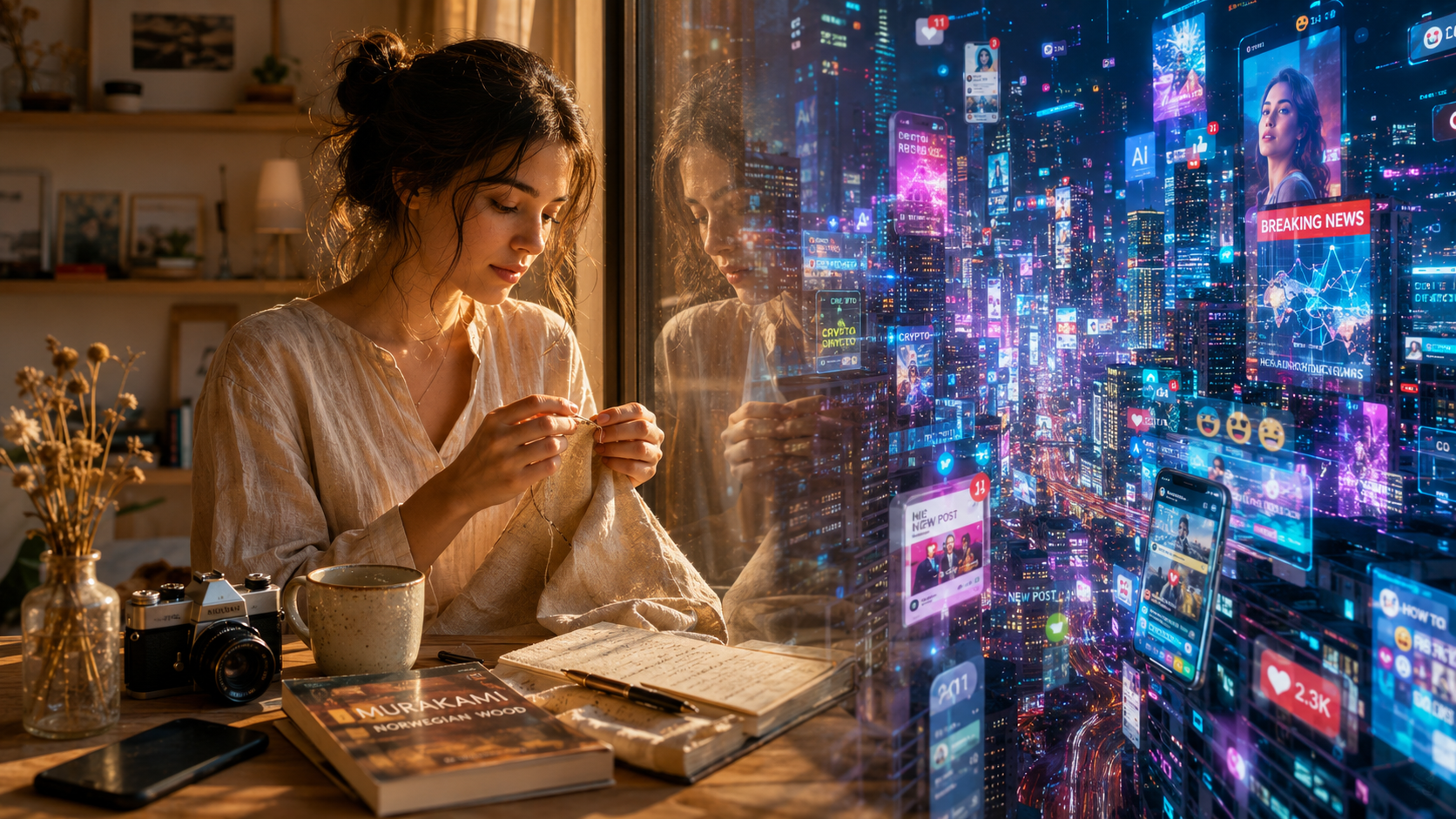
But when you’re threading a needle, shaping clay, or staining wood? The feedback loop is immediate, tangible, and deeply rewarding. You see the fabric come together. You feel the grain of the wood. You smell the pine and the glue. Every sense is engaged.
“There’s a profound psychological need for self-efficacy that our digital lives don’t satisfy,” says Dr. Marcus Webb, a clinical psychologist specializing in digital wellness at King’s College London, in an interview with Psychology Today. “When everything is abstract—likes, shares, algorithmic nudges—we lose a sense of personal agency. Analog hobbies reintroduce predictable cause-and-effect. You do something; you see the result. It’s incredibly grounding.”
Consider the data: a 2025 study from the University of California, Irvine, found that participants who engaged in just thirty minutes of a physical craft activity reported 42% lower cortisol levels and 37% higher self-reported satisfaction scores compared to those who spent the same amount of time on social media. The “analog effect” isn’t just in our heads—it’s measurable in our bloodstreams.
The Social Media Paradox: Digital Tools Enable Analog Lives
Here’s the irony that everyone is missing: the analog trend is fueled by social media. Gen Z isn’t abandoning digital platforms—they’re using them strategically to facilitate physical experiences.
TikTok and Douyin have become the world’s largest craft tutorials library. A teenager in rural France can watch a master potter in Japan throw a bowl, learn the technique in fifteen minutes, and then log off and try it with their own hands. The platform becomes a gateway, not a destination.
As one Douyin commenter recently wrote under a viral pottery video: “I don’t watch videos to escape reality. I watch them to return to reality with better tools.”
This is what researchers are calling the “post-digital” mindset. Technology is no longer the center of our lives—it’s a utility. A tool. A means to an end that exists in the physical world. It’s a profound shift from the “digital native” identity that defined the 2010s. Being digital is no longer aspirational; it’s just… infrastructure.
As we explored in our previous piece on digital minimalism, the most successful practitioners aren’t those who delete all their apps and move to a cabin. They’re the ones who curate their digital tools with surgical precision—using social media for inspiration, connection, and learning, and then deploying that knowledge in the physical realm.
The “Outdated” Revolution: What People Are Actually Doing
The analog revolution manifests in fascinating, sometimes surprising ways. It’s not just about crafts. It’s a wholesale reappraisal of what constitutes a “good life.”
The Return of Vinyl: For 19 years running, vinyl records have posted year-over-year growth. In 2025, vinyl sales surpassed compact discs for the first time since the 1980s. But it’s not about audio quality—it’s about ritual. The act of dropping a needle, reading liner notes, listening to an entire side without skipping. It’s intentional listening.
The Analog Writing Revival: Fountain pen sales are up 47% globally since 2023. Journaling apps are stagnating, while Moleskine and Leuchtturm notebooks are enjoying record sales. The Japanese stationery brand Hobonichi, famous for its annual planners, sold out its 2026 edition in hours—not because of scarcity, but because demand has exploded.
The Film Photography Renaissance: Fujifilm has restarted production of several discontinued film stocks to meet demand. The company’s Instax instant camera division is growing at 22% annually. Young photographers are actively choosing grain, light leaks, and the thrill of not knowing whether the shot worked—a direct antidote to the instant gratification of digital photography.
The Rise of “Visible Mending”: Instead of discarding torn clothes, Gen Z is embracing visible repair—stiching repairs with bright, contrasting thread, celebrating the flaw. The hashtag “#visiblemending” has over 400 million views on TikTok. It’s a direct rejection of fast fashion’s throwaway culture and a declaration that things can be loved back to life.
These aren’t isolated trends. They are expressions of a single, coherent philosophy: less optimization, more connection.
Beyond Hobbies: The Economic and Cultural Implications
The analog trend isn’t confined to individual lifestyle choices. It’s reshaping markets, business models, and entire industries.
The Hobby Economy: The craft and hobby industry is now valued at over $340 billion globally, with the fastest growth segment being adults aged 18-34. This has spawned a new generation of micro-entrepreneurs: Etsy shops, local makers, weekend market vendors. Millennials and Gen Z are starting side businesses based on their analog hobbies at rates three times higher than previous generations.
The Premiumization of Physical Objects: In an era of digital abundance, physical objects are becoming more valuable, not less. The market for handcrafted goods is growing at 8% annually, while mass-produced equivalents are stagnating. People are willing to pay premiums for objects with a human touch—a handmade mug costs 5x a factory-made one, and consumers are buying them.
The Shift in Leisure Time: Gallup’s 2026 Wellbeing Index found that young adults are spending 23% less time on entertainment screens (streaming, gaming, social media) compared to 2023. They’re devoting that time to “productive leisure”—learning a craft, gardening, cooking from scratch, building something. The concept of “productive leisure”—once a niche academic term—is now mainstream.
As a senior analyst at Deloitte noted in a recent report, “The companies that will win the next decade are not just selling products—they’re selling experiences of making. The physical economy is becoming a premium economy.”
A Practical Guide: How to Join the Analog Revolt
If this resonates with you, and you’re ready to put down the phone and pick up a tool, start small. The goal isn’t to abandon digital life—it’s to rebalance it.
Start with a Micro-Habit: Choose one analog activity and commit to fifteen minutes a day. It could be handwriting a journal entry. It could be sketching something in your vicinity. It could be caring for a houseplant. The key is consistency, not volume.
Embrace Imperfection: The point isn’t to produce museum-quality art. It’s to engage in the process. Your first ceramic bowl will be lopsided. Your first loaf of bread will be dense. Your first film roll will be overexposed. That’s the point. You’re not competing with anyone. You’re simply making.
Curate Your Digital Inputs: Use social media intentionally. Follow accounts that teach and inspire, not accounts that sell and distract. Then close the app and practice what you’ve learned.
Join a Community: The analog revolution is social, not solitary. Join a local craft circle. Attend a community pottery class. Find a book club that meets in person. The physical world is filled with people who share your desire for tangible connection.
Conclusion
We are living through a quiet, profound recalibration. The analog revolution isn’t about rejecting the digital—it’s about reclaiming something essential that we lost along the way. It’s about rediscovering the simple, visceral satisfaction of making something with your hands. It’s about reconnecting with the physical world that our ancestors inhabited for millennia, and that we’ve spent the last two decades escaping.
This isn’t a sign of decline. It’s a sign of maturity. It says that we’ve mastered the digital tools, extracted their value, and now we’re ready for something more. We’re ready for the rough grain of wood, the smell of clay, the imperfect stitch, the hand-written letter. We’re ready to be makers again.
The challenge, as always, is balance. The digital world isn’t going away, nor should it. But we have the power—right now, in this moment—to choose how we spend our limited, precious time. We can scroll, or we can create. We can consume, or we can make. The choice is ours, and increasingly, the world is choosing to create.
What do you think about the analog trend? Have you felt the pull away from screens and toward something more tangible? What’s your escape from the digital noise? Share your favorite hands-on hobby in the comments below—we genuinely want to know.