Introduction
On June 16, 2026, the Indian artificial intelligence ecosystem crossed a threshold that will echo through boardrooms in San Francisco, Beijing, and London. HCLTech invested ₹1,427 crore into homegrown AI startup Sarvam AI, propelling the company into the unicorn club with a post-money valuation of $1.5 billion. This followed a larger $234 million Series C round led by a consortium of global and domestic investors, marking the largest single funding event for an Indian AI foundation model company to date.
This is not just another funding headline. It is the sound of a new pole being planted in the geopolitical map of artificial intelligence. For years, the narrative has been binary: the United States builds the models, and China builds the alternatives. But with this deal, India has signaled that it intends to build its own lane — one defined by linguistic diversity, data sovereignty, and a distinct technological philosophy. As Anthropic grapples with new US export restrictions on its most advanced architectures, and Nvidia raises a staggering $25 billion in bonds to fuel its next-generation chip production, the global AI chessboard is shifting faster than most analysts predicted.
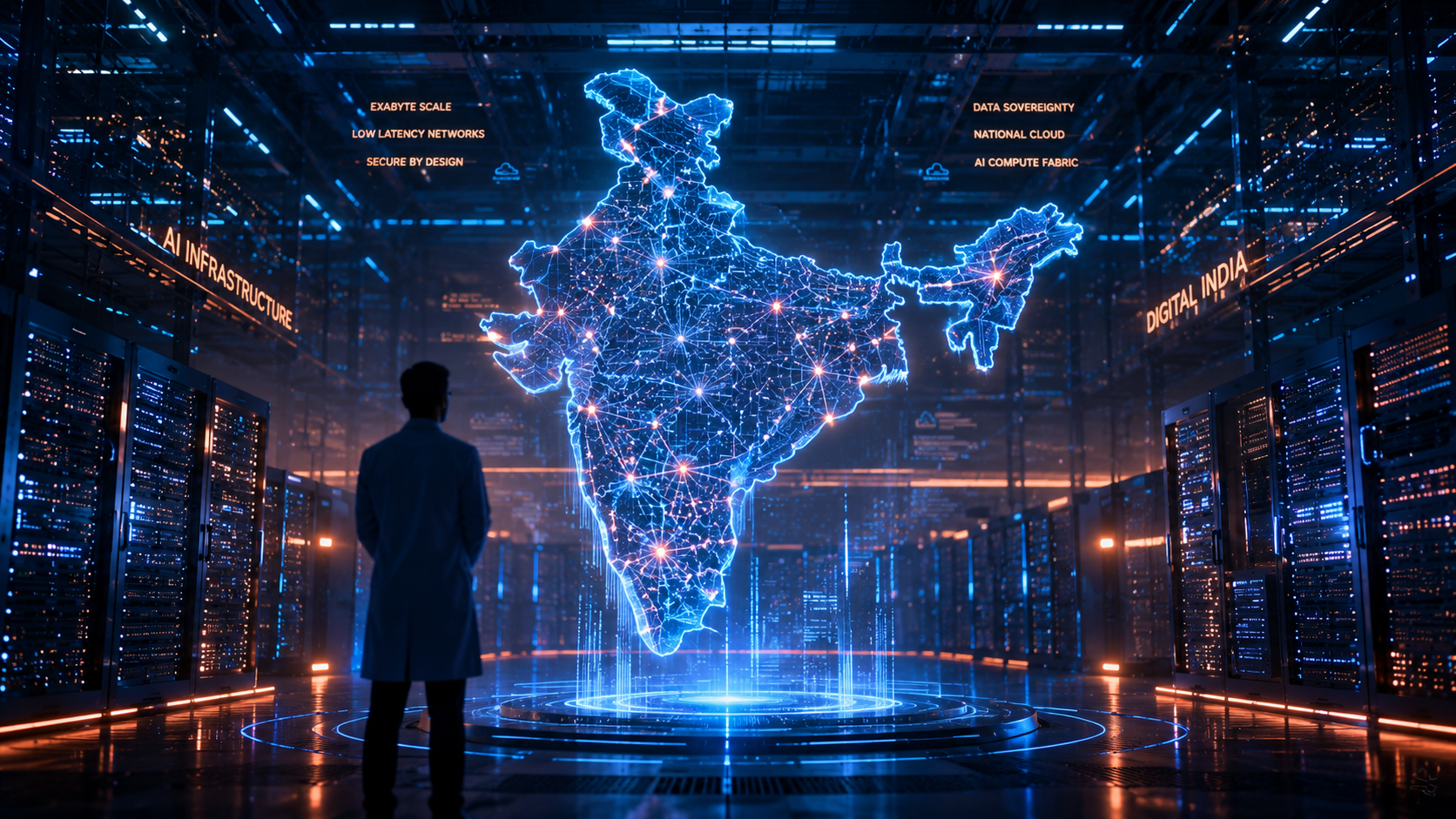
So, what exactly makes Sarvam AI different? And why should anyone outside of India’s tech corridors care? The answer lies in a concept that is rapidly becoming the most important buzzword in 2026: sovereign AI.
The Sarvam AI Story – More Than Just a Funding Round
To understand the magnitude of this moment, you have to look past the dollar signs. Sarvam AI, founded in 2023 by a team of former Google DeepMind and Microsoft Research engineers, set out with a deceptively simple mission: build large language models that truly understand India. Not just English, but the 22 scheduled languages and hundreds of dialects that make up the subcontinent’s linguistic fabric.
While OpenAI and Anthropic have been locked in a performance arms race on English benchmarks, Sarvam took a different path. They built a multilingual foundational model from the ground up, optimized for low-resource languages like Tamil, Telugu, and Marathi. Their breakthrough came in early 2026 when they released Sarvam-1, a model that outperformed GPT-4o on several Indic language reasoning tasks while requiring a fraction of the compute. That efficiency caught the eye of HCLTech, which had been searching for a strategic AI partner to embed into its enterprise services for the domestic and Southeast Asian markets.
“This is not an acquisition; it’s an alliance,” said a senior HCLTech executive in a press statement today, referring to the investment. “We are co-building the AI stack for India’s digital future.”
The Unicorn Valuation – Justified or Hype?
A $1.5 billion valuation for a three-year-old startup in a capital-intensive field might raise eyebrows, especially given the cooling of public AI markets in early 2026. But several factors justify the premium. First, Sarvam has secured anchor enterprise contracts with three of India’s largest public-sector banks and two state governments for citizen-facing AI services. Second, their compute strategy — partnering with domestic data center providers and leveraging optimized open-source architectures — has kept their training costs nearly 40% lower than comparable US-based foundation model companies, according to an internal investor deck reviewed by TrendTalk.
Most importantly, Sarvam is not just selling models; they are selling AI sovereignty. As one Mumbai-based partner at a global VC firm told us: “If you are an Indian enterprise, do you really want your customer data flowing through servers in Virginia or Beijing? Sarvam offers a trusted, local alternative. That has an intrinsic value that goes beyond standard revenue multiples.”
This echoes a broader trend we identified in our recent deep-dive on AI infrastructure, where we noted that regional data residency laws are becoming the single most important driver of enterprise AI procurement decisions. The Sarvam-HCLTech deal is the clearest proof point yet.
Sovereign AI – Why Nations Are Racing to Build Their Own Models
The term “sovereign AI” was coined by policymakers to describe a nation’s ability to develop, deploy, and govern artificial intelligence systems without being dependent on foreign entities for critical capabilities. In 2026, this has moved from academic white papers to the war rooms of national security councils.
Consider the recent moves by the United States. In May, the Department of Commerce imposed new licensing requirements on the export of advanced AI model weights to a list of countries, citing national security concerns. While India was not explicitly targeted, the message was clear: the US views its frontier AI models as strategic assets akin to nuclear technology. Meanwhile, China has doubled down on its New Generation AI Development Plan, flooding domestic AI firms with state-backed compute subsidies. Europe, too, has accelerated its EuroHPC initiative, pledging €5 billion to build a sovereign AI compute infrastructure that can rival AWS and Azure.
Into this fractured landscape steps India, with a unique advantage. Unlike Europe, which struggles with fragmented languages and cautious regulation, India has a unified digital payments and identity infrastructure (UPI and Aadhaar) that creates a massive, homogenous data ecosystem. Unlike China, India has a thriving open-source community and deep ties to Western research institutions. Sarvam AI is essentially the commercial spearhead of this strategic positioning.
The HCLTech Factor – A Corporate Pivot
HCLTech’s ₹1,427 crore investment is not just financial; it is deeply strategic. The IT services giant has been quietly pivoting from traditional outsourcing to “AI-first engineering.” By taking a significant minority stake in Sarvam, HCLTech gains preferential access to the startup’s foundational models, which it will integrate into its AI Force platform — a suite of enterprise tools targeting manufacturing, healthcare, and logistics.
This mirrors the playbook we saw in the cloud wars, where legacy IT firms like Accenture and Infosys partnered with hyperscalers. But here, HCLTech is betting on a homegrown horse. As the broader IT services sector faces margin compression from generative AI automation, owning a piece of the underlying model stack provides a hedge against obsolescence. It’s a bold move, and if successful, it will redefine how Indian IT competes globally in the next decade.
What This Means for the Global AI Order
The Sarvam AI unicorn event is not an isolated data point. It sits alongside a constellation of other moves that suggest the AI industry is entering a multipolar phase. Let’s look at the broader context:
-
Nvidia’s $25 Billion Bond Raise: Announced earlier this week, Nvidia is issuing corporate bonds to secure capital for its Blackwell Ultra chip production. This signals that despite the AI boom, supply chain constraints and high capital expenditures are forcing even the market leader to tap debt markets. For Indian startups like Sarvam, which rely on a mix of Nvidia GPUs and domestic alternatives, this creates both risk (higher chip costs) and opportunity (alternative chip startups gain traction).
-
Salesforce’s $3.6 Billion Fin Acquisition: The CRM giant’s acquisition of AI agent firm Fin for $3.6 billion, finalized last week, underscores the shift from “copilots” to “agents” that perform tasks autonomously. Sarvam AI’s roadmap includes a similar agentic framework tailored for Indian government workflows — a potentially massive market given the country’s digital public infrastructure.
-
Anthropic’s Regulatory Headwinds: Anthropic recently disclosed that it is in active discussions with US regulators over its latest model release, which some officials fear could be misused. This regulatory friction is precisely the opening that non-US AI firms are exploiting. Sarvam AI’s CEO made a point of noting today that their models are “openly available for audit by Indian regulatory bodies,” a clear contrast to the secretive release strategies of US frontier labs.
Taken together, these events paint a picture of an industry that is rapidly fragmenting along geopolitical lines. We are moving away from a single, unified global AI ecosystem toward a world of regional AI blocs, each with its own models, standards, and data regimes.
India’s Hidden Advantage: Data Diversity
One of the most underappreciated aspects of India’s AI push is the diversity of its data. A model trained on Indian English, Hindi, and regional languages inherently learns a broader spectrum of human reasoning patterns than one trained predominantly on Western internet text. This could lead to what researchers call “representational robustness” — models that are less prone to cultural biases and more adaptable to non-Western contexts.
According to a recent study from the Indian Institute of Science, multilingual models trained with a significant proportion of Dravidian and Indo-Aryan language data showed a 22% improvement in complex reasoning tasks involving spatial logic and common sense, compared to monolingual English models. Sarvam AI has reportedly incorporated these findings into their training pipeline, giving them a distinctive technical edge.
Furthermore, India’s Digital Public Infrastructure — including the Unified Payments Interface (UPI) and the Open Network for Digital Commerce (ONDC) — generates a torrent of structured transactional data. With proper anonymization, this data can be used to train models that understand financial behavior, supply chain dynamics, and consumer trust in ways that are impossible to replicate elsewhere. Sarvam’s exclusive partnerships with several DPI-enabled entities give them a data moat that is legally and culturally defensible.
Conclusion
The rise of Sarvam AI to unicorn status is a seminal moment, not just for Indian tech, but for the global AI project. It signals that the future of artificial intelligence will not be written in a single language, hosted on a single cloud, or governed by a single regulatory framework. Instead, we are witnessing the birth of a polycentric AI world — one where sovereignty, linguistic inclusion, and strategic independence are as important as raw performance.
Of course, challenges remain. Talent war is intensifying; Sarvam will have to compete with DeepMind and OpenAI for top-tier researchers. Compute costs, despite their efficiency gains, are still monumental. And the risk of regulatory overreach by an increasingly assertive Indian government could stifle innovation. But for now, the momentum is undeniable.
As the dust settles on today’s announcement, one thing is clear: the conversation about “which country will win the AI race” is outdated. The question is no longer who wins, but how many winners there will be — and whether they can cooperate before the fragmentation becomes permanent.
What do you think about India’s sovereign AI push? Is Sarvam AI a genuine challenger to the US and Chinese giants, or is the hype ahead of the hardware? Share your perspective in the comments below.